
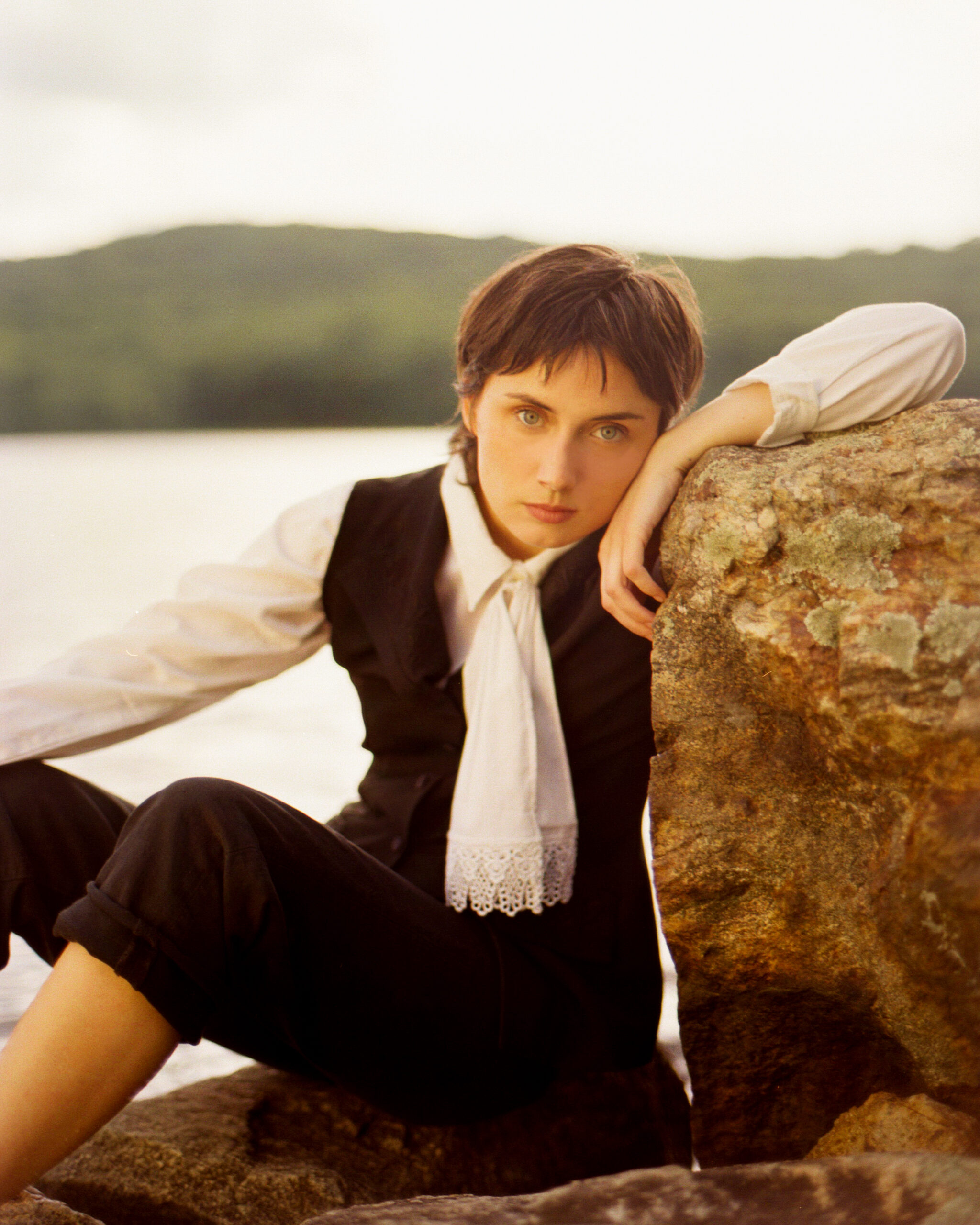
Katy Kirby is an artist that captured my attention with the track “Eyelids.” This small detail of a person being put under the sonic microscope offers an intimate window into the mind of Kirby and the soft embrace her music brings to the table.
I had the opportunity to sit down with Kirby to discuss her latest project, Blue Raspberry. An unflinching letter addressed to a relationship kissed goodbye. The 11-track project released on January 26th, 2024, is arguably the most honest work by Katy Kirby to date.
Blue Raspberry Deluxe was also released on July 12th and features two new tracks “Headlights” and “Naperville” which further dig into the honesty this record already refused to shy away from in the initial release.
“I’m really glad that I kind of chose to not really hire an outside producer for this record but instead work with my band, who engineered and produced the first record that I put out… I’m really glad we did that; it was really just us, and it felt like there weren’t any other adults in the room. [The band are also the people who have the most patience with me in terms of completing something, so I’m very grateful I did all that.” Kirby explained when talking about the process of starting production on Blue Raspberry.
Sonically, I wondered if there were any differences from the band not hiring an outside producer. “We definitely… It was the same people, but we had way more resources because we had a much bigger record label behind us before we started recording.” It was great to hear that the artist was getting support from their label to be able to create an incredible body of work.
“We were kind of unused to working with support and resources. We were so used to recording things in our houses and just kind of using what we had that it felt like it made it more difficult to actually be able to go into a whole studio for multiple days. I don’t know; I don’t think it sounds that different personally, but it does sound a little bit prettier and bigger, I think, in places at least.” The artist explained this when reflecting on past projects without the support of Anti-.
After hearing about the teamwork of the band and how that all came together, I wondered about collaboration with fellow artists outside of their team. Kirby had this to say about the track made with Christian Lee Hudson that the pair made over FaceTime.
“It was really weird. Quite honestly, I don’t always know what to do when co-writing, so the way Christian and I did it was, I think we just kind of sat on FaceTime, exchanged a bunch of one-liners, and they kind of clumped together in a way that I found interesting. I kind of took those pieces, stitched them together, and sent him a draft. He was like, ‘great’ but I think he forgot that we wrote that song because he texted me to double check later.”
Given that the pair had written different lines and brought them together, Kirby elaborated on what that process specifically was like. “We both tend to write about similar stuff; I don’t know. Christian’s really good at capturing despair, especially emotions, [in] really succinct little chunks of lyrics, so I copped a few of those off of him and combined it and then it kind of narratively made sense.”
The artist also later talked about a dear friend named Logan, who she has been working with since 2018 at the start of her music career and will periodically send voice memos in a way that allows the artist to reimagine a song and really take on a different approach.
Sitting in front of me was an artist who has been able to cultivate such incredible music with so many other talented people and really step into the role of being able to make magic happen with other creatives. However, I was individually curious about how the artist came to really love music and want to pursue this avenue in life.
When first exploring where the artist found their love of music, she fittingly credited Christmas songs: “All of those songs are really beautiful, and it was always fun to sing them with people.” She went on to explain, “I tend to be a fan of the really, really old ones; if a melody is from the 14th century, it’s probably pretty good.” Specifically, “Where Are You Christmas?” and a cover that was done by the artist Hannah Diamond.
Branching off from talks about the holiday, we dug into the impacts of religion and how the religious background of the musician has bled into her work. The music video for the track “Table” plays into this imagery as a lot of it takes place in a church, offering a stained glass backdrop to an emotionally charged track with the juxtaposition of destruction in a sacred space.
“I asked the oldest friend I have; her name is Lane Rogers, and she directed the video. I asked her to do that because we went to high school together, we’ve been friends for a really long time, and we come from the same religious context. We share that more than anyone else I know really, other than my siblings.”
Kirby went on to say, “I knew that [“Table”] was sort of this… actually not a super straightforward account of what it feels like to grow up in that context, and I thought that she would understand that. She does, I think. Also, she understands that it’s just a silly little song.”
What struck me during this conversation was the way that Kirby, as an artist, is able to touch on such deep and important topics while still clearly having fun with the process and making sure that it is true to the creative vision at hand. “[Lane] was like, ‘You should just destroy a table.’
The musician went on to explain that the music video is tapping into religious history: “There are a lot of people that have been in America a long time, but… all of them were Protestant, and a lot of them were Quakers or somewhere in that vein, and that’s actually a section of the Christian church that I am really fond of still and that I really fuck with honestly.” Despite positive feelings for the church, the singer did want to acknowledge the conflicting feelings when it comes to religious practice and reflect that in the music video.
“I tried to recreate a vaguely historical feeling, sort of like costume, I guess, to acknowledge the love-hate bit. I don’t know; it’s not really love or hate, but it’s this admiration-disdained tension in how I think about my spiritual heritage, right? Because it’s a lot of disdain that some of those people did horrible things, but there are also parts of that tradition that I find useful and kind of durable.”
We went on to discuss the artist’s identity as a queer person growing up and how that related to her religious experience: “Well, fortunately, I come from a family and, I guess, a religious community that was never that freaked out about gay stuff in general.”
“My family, especially now, is perfectly fine and precious, and it is literally no big deal. They haven’t batted an eye at anything that has come out around this record. I don’t know; even a long time ago, I didn’t really buy the thing that… God having a problem with people being gay just never really made sense to me.” It was refreshing to see somebody who has grown up in a religious context where they can be accepted for who they are and not feel immense pressure to conform to their identity.
“Even if he is kind of upset about it, I feel like that’s a more understandable mistake. You know what I mean. If God’s like so, actually, ‘gay stuff, bad.’ And you’re like, ‘Okay, totally, right. You are God after all, but I was just going to be decent to people and not horrible to them, and that was the rule of thumb I was going off of.’ I feel like I would be like, ‘Right. Sure, yeah, that was definitely the better mistake to make than the other one, where you’re arbitrarily awful to people. That’s just an imagined conversation I had with God as an 11-year-old, I guess.”
Given the intimacy level of Kirby’s discography and how her personal lived experiences tie into her art, I asked where her writing process begins. “That looks like piecing together things I’ve had for a long time, usually. [I] rely pretty heavily on my notes app, so yeah, usually when I sit down to write an album, I’m kind of just sitting down to finish things that already exist that I’ve been tinkering with for a while.” She said.
Since the songs are usually sung, we then talked about how that changes the relationship with the music in terms of cohesion and tracklisting. “I don’t know. Yeah, I have no idea. I didn’t really intend to write a lot of songs that overlapped or had dialogue between them. But you know, they’re all coming from my subconscious brain at some point, so they were connected. I guess just because they were coming from the same place, I wasn’t really intending that, but it just happened.” The question remains a mystery, though it is common for an artist to gravitate towards particular topics, especially when they are going through something in their lives.
There’s a sort of emotional thread that can attach itself to a writer and will not let go until you fully process an event, and even then, it can stick in your mind. However, the artist went on to say, “There’s a couple songs that I just put on there because they’re fun, like “Table,” for instance.”
The music videos truly act as an extension of this fun that Kirby perfectly infuses into a lot of her work. Outside of “Table,” we also discussed the creation of the music video for “Cubic Zirconia.” A track that Kirby credited as the most difficult to get right on the record, with three different versions made.
“That was a really fun process. I really like music videos. I feel like I don’t watch them that often, but when I do, I really love them. I tend to be really intense about music videos and their connection to the song, and I’m not always able to pull it off, but I guess I just want them to support the song in a vibe way rather than in a narrative way. So Cubic Zirconia is fun and gay and summery kind of, and so we just tried to make something fun and gay and summery.”
It’s incredible that Kirby did not shy away from making something gay and fun, especially given that this album details the artist’s queer relationship and what it was like to explore this new territory openly for the public to hear.
“I mean, there’s one or there’s one or two songs that I finished after my first queer relationship ended, and so “Alexandria” primarily. On Blue Raspberry, I wanted to tell as much of that story as I could, and it is very heavily about one person, or at least that’s what I think of when I think of those songs. I am thinking of that person, how it began, how it was in the in the middle, how it ended, and stuff surrounding it. Yeah, I guess I’m just trying to tell the story of that relationship with some fun embellishments to amuse myself.”
When asked what it was like to explore such a pivotal relationship through the writing process, the musician had this to say: “I didn’t know that I was navigating them through my writing until after I’d written them, and then after the queer relationship was underway. So, it did feel a little bit like I wrote my way into it, kind of, and yeah, it was kind of spooky how prescient those songs were.”
Self-discovery and having fun with the process were clearly at the forefront of the process behind Blue Raspberry. As a listener, you follow the journey with the band through this relationship and what it was like for it to be highlighted.
Given how intimate the record is towards this connection with another person, we then discussed what it’s like to balance that vulnerability with an audience. “Yeah, that’s the other thing where it felt like that decision was already made for me because the songs were already done. It does feel quite vulnerable, frankly, and I don’t love it all the time. But I think, I don’t know… I guess I just decided, ‘Well, I said it in the songs, so maybe people won’t make me say things in interviews about what happened. Maybe I’ll have to talk about it slightly less if it’s really obvious in the song, so that’s what I’m kind of comforting myself with, that at least the glory details of that relationship are less interesting because of the way the song is written. I actually haven’t really thought about that until this moment.
I mentioned how everything is sort of laid out on the table to be taken as they will, and it can be left to that. In response, the singer said, “Right, and then it’s kind of like I’ve maxed out my limit of explaining what happened.” Though Kirby mentioned that her mom still asks.
Kirby credited “Fences” as her favorite song off of the record, saying, “It’s virtually just the demo. I don’t think that we changed anything about it. [The track just came together so quickly and so magically in a variety of ways that I feel kind of mystified by that still.”
Outside of the details of the relationship, the musician shed light on the fact that the album also speaks to artificiality and beauty standards. “I was thinking about writing; it was this thought exercise; I was thinking about how I would write sort of one of those longing, kind of sweet, male gazey country songs or love songs that are about a woman, like kind of that subgenre.”
The singer said, especially when living in Nashville, she was exposed to a lot of country music and those sonic elements being played within the music around her. “I thought about how something I admire in people, and maybe women in particular, is that there’s just so many different choices about how to present yourself every day, and it’s very sweet to see evidence of those choices… I came to this concept of disdain for the idea of authenticity as being better than the technically unnatural or technically inorganic.”
Dolly Parton came up as a particular example: “She talks about it ‘costing a lot of money to look this cheap and how she kind of celebrates having big fake tits, wearing wigs, and having sort of all these artificial physical attachments that make up her image, and that’s kind of the most lovable thing about her in a lot of ways, or that’s something really easy to cherish in her, that she is so joyful about playing around with the way that she looks and not having any qualms about wanting to appease people in terms of what they think is natural or authentic. The way that she’s never really cared about that, I think people find it really magical and powerful.”
“Dolly Parton’s not the only one, but I was thinking about women who have that kind of magic and courage about them where they’re not embarrassed about it being evident that they’ve made aesthetic choices about their appearance and that they did think about them, and so Blue Raspberry being an artificial flavor or something like that was just the best way I could think to explain that concept.
So many women in today’s world, especially on social media, are put under a microscope for people to dissect and analyze. There’s something so refreshing about being unapologetic about the appearance that you have, especially when in the limelight, and the more that women are able to speak up about having these insecurities, the more normalized it becomes to live with them or make changes that make you feel better within your own body.
In today’s world, as a musician, it is expected for you to be online and keep up a social media presence, or to be very energetic on stage. “I struggle with the social media one way more than the stage one, because the stage thing it’s temporal, and it’s not going to be around forever, and it’s really contextual. I’m really just talking to the people in the room.”
“Social media is kind of weird. I didn’t have social media until I was 19 or 20 or something; I just didn’t, and I had a flip phone, so I don’t love social media, but I also do love social media, and it feels like it grants me access to the sort of lunchtime chats and sort of little inner musings of brilliant people. I do treasure that. I don’t know if authenticity is possible in those situations, so just try to make what feels like a good choice, because the real me doesn’t want to be on social media at all.”
On the topic of stage presence, we also discussed favorite songs to play live and what it’s like to bring to life a live performance. “Table” was the track that Katy Kirby credited as her favorite to perform live because it is loud the whole time. The artist reminisced about a previous tour with the Illuminati Hotties, whose drummer had the most fun time possible. The time on tour inspired the artist to write more fun songs for her band to play, and she dubbed it “objectively the most fun” to perform.
When asked overall what Kirby learned over the course of making this record, she said, “I’m very neurotic and not a great planner.” But when we went into talking about the little ad libs that are on a lot of the songs, the artist explained that the band helps to make those micro decisions. Alberto Seawald was credited as one of the people who collaboratively helped to make these decisions on the record.
Overall, the artist said that her biggest goal for her career has been met by being signed to their new label, and she is excited for more to come. Kirby has also announced tour dates including a show in New York.
To hear more about the process of making the record, including tour stories that have happened, like meeting Courtney Barnett, a discussion about energy drinks, and more about life outside of music, you can check out the full interview on YouTube.
Leave a Reply