
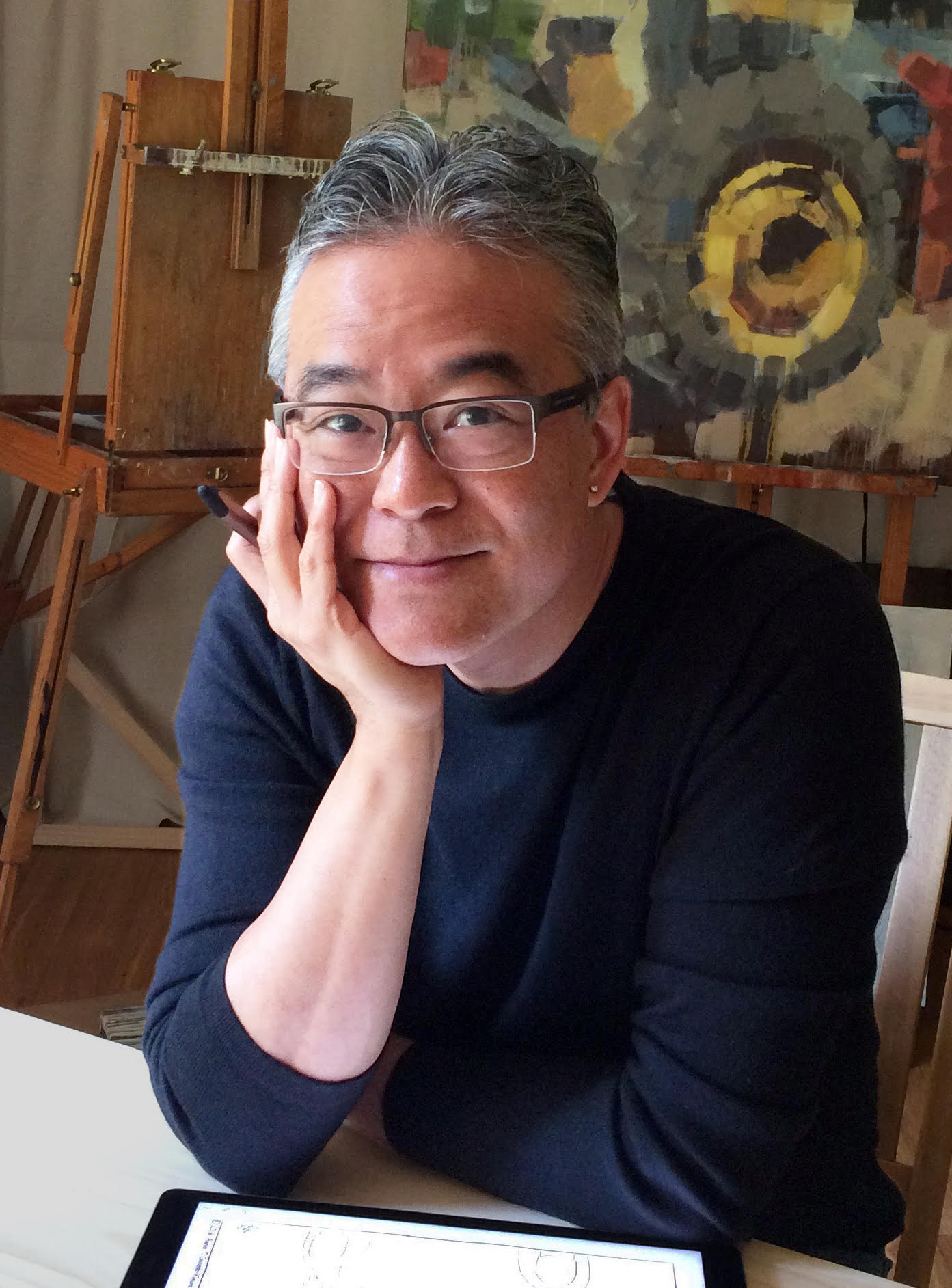
My appreciation for Aaron Caycedo-Kimura’s work began at a reading in my town. The rain poured down hard as my friend and I sat drenched in the small back room of a tea shop, but it was worth it.
What stuck with me was the openness and emotion that strikes you in his poetry through everyday concrete images, one example being a text message containing only a heart emoji sent from the couch on the imagined last day of life.
So, when I saw him read again this year and still felt the emotional impact the same as if it was the first time hearing the poems, I knew I wanted to talk to Kimura more in depth about his work and what it means to him.
On June 29, he and I discussed these themes and his creative process for my show “Wrinkled Page Radio” on WXCI 91.7. We opened the conversation by talking about his career not only as a writer but as a painter and how he got his start writing poetry.
When asked how the two art forms of painting and writing sort of combined for him, especially since painting is so visual, he explained that they can inform each other but don’t typically come together in any particular way. He does, however, have the idea for an upcoming chapbook that he would like to write where he specifically combines the two forms. Up to this point in his career, the act of combining mediums has been a rarity.
I then wanted to talk about the use of concrete images in his work and how his writing is particularly grounded by everyday objects or scenes. He did mention that his background in painting and being a very visual person is what helps to get that across in that way. “When I’m writing, I’m constantly consciously thinking of image and also sound.”
Kimura specifically has a gift for framing his work around an audience. He does not want to tell his readers how to feel. Instead, he focuses on how his audience will understand and enjoy his poetry as they see fit. He wants each person to leave his writing with a personalized interpretation of his work. He described his work as a “stage.”
The poet revealed that his wife is truly the inspiration behind writing poetry; she would ask for his opinion on her poem drafts after her writing class. That’s when he decided to take a class for himself and be able to provide her with feedback that was useful. At the same time the pair would attend poetry readings together. “With all of that inspiration, how could you not go home and try to write something of your own?” he said in reference to that experience.
When asked about whether sharing the poetry with Luisa gave him the courage to publish his work, Kimura said, “Absolutely, Luisa was my first teacher… she’s my first reader, I’m her first reader.” The bond that these two have becomes clear even when reading his collection as there is a section about their relationship in the later section of the book. He described poetry as part of their adventure together. That later section in particular brings a lot of light to the heavier topics that Common Grace covers, and his love for Luisa shines through.
Common Grace is a collection that details the loss of both of Kimura’s parents and what it was like growing up with them. The poet has opened up about how this is a way of being able to memorialize them and to connect to his parents’ pasts.
We talked about how the collection was compiled and he said that a ton of different poems were selected over the course of time to go into the collection and of course had a central theme of talking about the loved ones in his life. Many of the individual poems had been previously published among different publications.
The poet also mentioned that he has only been seriously writing poetry for 6 to 10 years and that it was a rocky process of putting together this first manuscript overall, although the sections had come together very naturally. Kimura mentioned that the next manuscript will definitely be a much smoother process to put together.
It was in 2017 that the poet began to take himself seriously and got a mentor through the AWP Writer to Writer Mentorship Program. He worked with Matthew Thornburn, and he said that he continues to be a good friend. “He brought me to a level of feeling comfortable enough to apply to MFA programs,” he said. This was a major step for Kimura as he had never been in a writing class or a workshop prior to that year.
He also opened up about feeling as though he is playing catch up due to his age and the stage of his life in which he is releasing his poetry for the first time. He mentioned that, had he been in his twenties like a lot of his cohorts, he would have waited to publish the work until it matured a bit more. When the opportunity presented itself to publish a book, he took it to make up for lost time.
From an outside perspective, his work reads as brilliant regardless of age. It has a very experienced voice when it comes to grappling with such complex topics. Without his lived experience, his writing may not have come across in such a nuanced manner, not only by capturing adolescence but adulthood as well and the way the two come together upon reflection.
Not only can you tell he has immense talent in the way he eloquently captures his emotions, but he is very appreciative to the people that he has worked with to get him to this point, including his editor Catherine, his publishing team, and the people who have taught and support him.
When reading his work, I noticed Kimura likes to play around with many different forms. While we discussed poetic forms, he talked about how he will try a number of different structures for poems before he is happy with them and that there are definitely poems that take him longer to craft.
The acts of writing a poem and revising it are very common for poets although he mentioned that, of course, the ideal situation is to be able to just write it and be done with it once it’s sent off for publication. He noted how, even at certain readings, he will take out little phrases or things that he wanted to change. Overall, he mentioned that he likes his poems to be “very tight” including in the phrasing, It is this attention to detail that allows for such clear and hard-hitting articulation when you’re reading.
In a newer collection, the poet is writing about his experience as a musician and what that was like for him. He truly has a unique experience and way of looking at art that not every writer has due to the fact that he has explored so many different art forms.
The fact that he so carefully explores a lot of art forms has clearly paid off as his new collection. Common Grace was published by Beacon Press, the same publishing company as notable poets like Mary Oliver, which is a feat especially in today’s poetry world. He also submitted the collection to a contest as part of being published, which takes a lot of courage, especially given the subject matter.
Despite the fact that this collection was not written all at once, it reads so seamlessly as an audience member getting to experience these different poems and how they come together to paint a picture.
The collection not only details his parents’ time reconciling with World War II, but with marriage, having children, settling in California, and then how they became sick and eventually passed. I wondered what it was like to open up in this way about such vulnerable topics.
Kimura described the process of writing this project as “probably the most profound experience [he’s] ever had” in terms of losing both of his parents. He described the writing process as “wonderful to write about,” as it heavily helped him to process his own grief.
It became immediately clear that he had a great relationship with his parents and that writing this book was a way to honor them. He was right there with them when they were going through their passings and described the poems about losing his parents in particular as a celebration of his parents’ lives and to keep them alive in his work.
Kimura went on to explain that he still is writing about them. The separation that he had from his parents physically by living on completely opposite sides of the United States (with him being located in Connecticut and them in California) helps him to feel as though they are still alive in a sense.
I understood what he meant immediately as I had lost my grandmother last year and at times it’s easy to feel as though she is still alive and going about her regular routine when I would barely see her on a regular basis.
When asked what it was like to make peace with putting such personal works out into the world, Kimura said that he tends to be very introverted and that the poems are “terribly personal.” However, he tends to separate himself from the work once it’s out into the world or published into a book.
We went back to talk about his first chapbook that was ever published called Ubasute. He cited this collection and the process of getting that published as an experience that led him to the confidence to put out his next works.
That project in particular also explores his relationship with his parents and their passing. Ubasute is a Japanese tradition that, according to the New Zealand Herald, is the act of “abandoning an elderly or ailing relative in a remote spot.” Typically, it is done so that the person may pass.
The chapbook also shares a name with one of the sections in Common Grace; he knew that he wanted the idea of Ubasute to be a full-length collection. The chapbook contest, however, required that the submitted body of work should not include more than 20 poems. Even though he was asked if he would like to add more poems once it was being published, he said he “fell in love” with the way he crafted the shorter collection. After that is when his next collection began to come to life.
The idea for this first collection began with a poem entitled “Burial.” While they did want to honor his wishes, he said, “My father wrote in a letter to my sister and me that he didn’t want a funeral, he didn’t want a memorial service, he didn’t want an obituary in the newspaper. That was his wish, and so we wanted to honor that. But at the same time, I thought, ‘Oh my god, how sad that is,’ because if you don’t have an obituary in the newspaper, which eventually gets put online, nobody’s going to know you existed.”
I was struck by what a beautiful way he chose to honor them by dedicating the book to them while still following their wishes following their passing. “People will know that they existed and how wonderful they were,” he said.
We also delved into how it was specifically easier to write about his father and he even began to write about him while he was still alive and sick since it had progressed relatively quickly. It’s because he was closer to his mother that it took longer to write about her. At one point in time, he had moved back to California for seven months to take care of her. He had a lot of hands-on experience with his parents’ ailments before they passed.
He mentioned his mother’s old photos that are in the basement and how those in particular helped him to see his parents as people rather than just his parents. He began to compare his experiences to his mother’s at the same ages, and that really struck a large connection for Kimura.
We also went on to talk about mortality and if writing this collection helped him to come to terms with the idea of death. He touched on how it’s a hard topic not to think about when you’re losing so many people around you but that he has personally come to terms with the idea of passing and instead focuses on bringing as much light and abundance into life as possible. “It makes me appreciate what I do have now and the contentment I have.”
The conversation naturally turned towards vulnerability as there’s a particular poem at the beginning of Common Grace where he walks in on his parents embracing and being affectionate with each other. “Whenever I think about that moment, I still cringe. I grew up in a Japanese-American home. My father was Japanese-American born in the United States, but his family was never physically or verbally affectionate. My mother was also but born in the United States but grew up in Japan and was definitely not physically or verbally affectionate.”
Coming from that background, it’s incredible to see the amount of vulnerability and love he is willing to show right on the page to his audience. Kimura went on to explain that he is verbally affectionate, especially in comparison to his parents. Despite being a sensitive person, he tries not to be too sentimental in his writing.
Throughout the collection, he also features encounters that he has with strangers, which feel as though they speak to the human connection as a whole. The poet explained that he wanted to be able to surprise readers and bring in a new character rather than just focusing on his parents.
Delving deeper into his experience as a Japanese-American artist, I asked what it’s like for him when moments of childhood or speaking Japanese randomly pop up for him. “It’s weird, it’s very humorous, I don’t speak Japanese. My mother tried to teach me, but my sister and I were the only Asians in our elementary school. Certainly in my class I was the only Asian, and so it was very difficult. You want to be accepted, you don’t want to be different.”
“Also, for some reason, foreign languages are not easy for me to learn. There are words that we used to use in our house. You know, our house was a mix of English, everyone spoke English. But there were little words here and there in Japanese that were thrown in just naturally, you know?” Ohashi stuck out in particular (meaning chopsticks.) There is a poem in the collection where he is yelling the word in Japanese and can’t think of the translation to tell his wife. Random moments certainly pop up for him from childhood, and that is reflected in some of these pieces featured.
In the collection, he also covers how his mother had hands-on experience as a teenager with World War II. In the interview, he specifically mentioned fire bombs being dropped in Tokyo and how her family had to run from the fires. Kimura wanted to cover not only what his parents had been through but what they had accomplished in their lives, and World War II is something that specifically stuck with his mother.
He mentioned the war and the impacts that it had are always felt especially when it comes to facing racism. “I think it was really magnified by the war. [Being considered] the enemy.” He touched on growing up having been called slurs. Beyond covering grief and love, this collection is an exploration of growing up and culture.
We then transitioned to talking about moments in time that are captured in the collection like a fishbone in his throat or a needle going into his eye, and he mentioned that he wanted to be able to include moments of humor and light throughout the collection, and that was his way of doing so. The light of the book ultimately ties back to his wife Luisa and the joy that she brings into his life as well.
Kimura has not stopped publishing new works and can be found in different publications such as Salamander and Lunch Ticket. He described himself as a “maker” and said that he never stops making poetry or paintings and that there is “life after book”
I asked what advice he would give to people who would like to be published but aren’t really sure where to start. He mentioned that you cannot do it alone, and it’s great to have another pair of eyes on your work and people that you trust. “Have them help you shape your work and/or clarify for yourself what you’re trying to do… Just take a deep breath and get it out there.”
To hear a reading at the end of the interview of some of Aaron’s poems as well as more of what we went over in the interview including details about his father, his marriage, the writing process/the process of doing readings after finishing writing and some of his favorite musical artists which are mentioned in the collection and have inspired him, you can listen to the full interview on SoundCloud and actually watch the interview over on YouTube.
You can also find Aaron’s list of published poems on his website and Instagram which will link you to not only more recently published works but also where you can purchase his collections and paintings!
Leave a Reply