
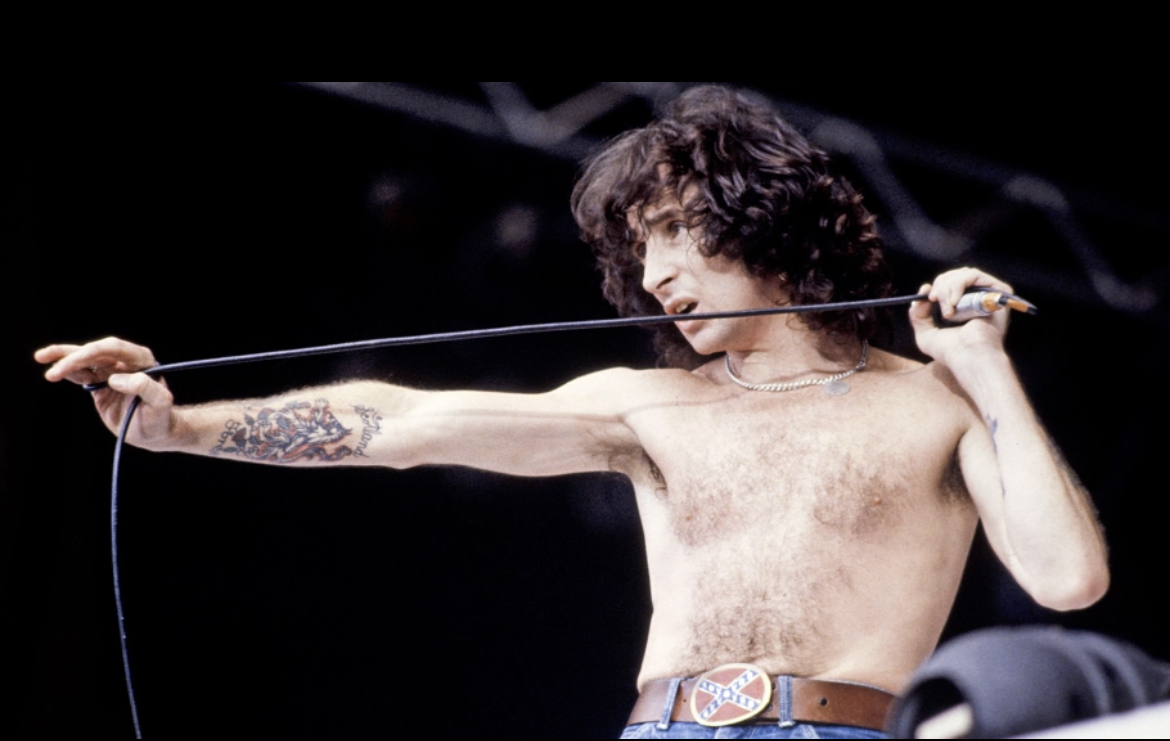
“Lead singer Bon Scott spits out his vocals with a truly annoying aggression which, I suppose, is the only way to do it when all you seem to care about is being a star so that you can get laid every night.” – Billy Altman, Rolling Stone (December 16, 1976)
When the name Bon Scott is brought up, what comes to mind?
The voice? A nasally, sometimes gravelly tone able to scream and belt? A horny, shirtless Australian with a few missing teeth and a woman on each arm? A talented songwriter with a penchant for wordplay and double-entendre?
Billy Altman may have seen him a little differently, but I, and many other rock fans around the world, truly believe that Bon Scott is the greatest frontman in rock history.
Today marks what would’ve been his 77th birthday, in the year marking AC/DC’s 50th anniversary. From a young Scottish boy (born Ronald Belford Scott in 1946) trying to assimilate to Australian life to one of the country’s most famous rockers. Scott has earned a place in music history, but the cultural image of him that people hold, the stories of his wild nights out and his caution-to-the-wind lifestyle, often overshadow his musicianship and looks into why the music he created is so fondly remembered. Dive into one song from each Bon Scott-era AC/DC album (internationally released) and see what I mean.
High Voltage – “It’s a Long Way to the Top (If You Wanna Rock ‘N’ Roll)”
In the beginning, back in 1976, High Voltage, a combination of AC/DC’s two previous albums (another album called High Voltage and T.N.T.) introduced the band to audiences outside of their native Australia.
Many musicians have written their own songs about fame, either centering around being filthy rich or actively loathing their celebrity status. However, Scott is one of the few songwriters to relay the honest truth about making it to the top. It isn’t just a long, rough journey, but one that can easily involve being mistreated, taken advantage of, hopping from cheap motel to an even cheaper motel, and dealing with hostile audiences. The song takes these hardships and shrugs them off as all being part of the journey. The members of AC/DC are not the kind of band to make headlines about petty drama or flaunting their wealth, and this song has lived on as both as a classic rock song and as the group’s anthem, if you will. A reason for its staying power is the bagpipe solo, performed by Scott, who engages in an upbeat call-and-response with Angus Young’s guitar mid-song.
Dirty Deeds Done Dirt Cheap – “Ride On”
AC/DC fans could spend hours debating the best song on an album, and Dirty Deeds Done Dirt Cheap is no exception. It’s filled with fan favorites, but a notable mention is “Ride On,” the second to last song on album. It is the only real sad number you’ll ever hear from this band. The song goes head-first into the blues sound that inspired AC/DC as musicians and takes the time to bring a song that, although different, resonates on a level other than a sudden burst of rock-induced adrenaline. Scott delivers a soulful take on a man who looks back on his life over a few drinks. One has to wonder what personal events in his own life he had in mind while writing and recording the song. The song itself hints at a more reflective side to Scott that does not get explored in AC/DC songs. The song that follows reverts back to usual AC/DC schtick, and is a good one at that. But, for the brief glimpse we get into the mind of Bon Scott, the person beneath the tattoos and jeans, “Ride On” is the kind of gem you didn’t expect to find but cherished anyway.
Let There Be Rock – “Let There Be Rock”
And so it was written, in the year 1977, that Bon Scott declared the title phrase and created an iconic AC/DC concert staple.
1955 is the year when rock and roll began, coinciding with the birth of Angus Young in March of that year, and Scott relays the history of rock and roll through Biblical references and a little Chuck Berry, for good measure. Unlike “Long Way,” Scott has an enthusiasm for rock, and that spirit is heard through both his lyrics, which play around with rhyme structure, and the excitement in his voice. Although most of the song is fascinated by Young’s guitar solos, which are godly in it of themselves, Scott’s familiar growl reaches the heavens and far beyond.
The promotional video plays into the Christian motif, with Scott portraying a priest giving a sermon and the rest of the band as altar boys, with Young sporting a green halo over his head. By the end, Scott no longer wears his priestly garb, which must’ve left some schoolgirls attending parochial schools speechless.
Powerage – “Rock ‘N’ Roll Damnation”
If “Let There Be Rock” was the band’s take on the church, then “Rock ‘N’ Roll Damnation” embraces the kind of attitude that preachers may point to as being the dreaded “Devil’s music.”
This anthem of rock and roll-fueled rebellion serves as the opening track of AC/DC’s 1978 fan favorite album, Powerage (is it “Power-AGE” or “Power-EDGE?”) Although it was recorded just to add a possible radio-friendly single onto the track listing, “Rock ‘N’ Roll Damnation” once again shows off the power and defiance in his voice. Despite his age (31 at the time he was recording this song), Scott has a remarkable gift of not only tapping into the feeling of every teenager telling authority where they can go without sound like a man in his early 30s trying to connect with the youth. He knows what’s up and what he wants to say to let you know that.
Highway to Hell – “Night Prowler”
On his final album with AC/DC, Bon Scott unknowingly ended his rock and roll career, not with a reflective “Ride On” type track to be looked back on in hindsight, but with this slow, eerie song. It is another deviation in terms of style, as the song plays out almost like a horror film from the late 1970s, not the usual AC/DC aesthetic. Scott weaves a story dripping with chilling atmosphere and tension, and he gives a vocal performance that works perfectly with the tone and sound of the song. A slow rhythm pulsates beneath Scott describes climbing through a woman’s window, watching her as she sleeps (or tries to). He used what critics would call “annoying” to his advantage. He screams, howls, and sings in a scratchy tone that can’t be found in any other AC/DC song.
The song is now remembered in association with serial killer Richard Ramirez, nicknamed the “Night Stalker” by the press at the time, whose murderous spree was linked to not only this song, but the band in the 1980s. However, it is still remembered as a bluesy, hard rock finale to one of the band’s greatest albums.
Happy Birthday, Bon Scott. If you could see how revered you are today, built up as a god of rock, you’d see how much the hard work paid off. You made it to the top. Shazbot, nanu, nanu.
Leave a Reply