This article is produced in collaboration between the Echo editorial board and our partners at the Clio History Journal. For more of their articles, click here.
Edited by Hailey Strom
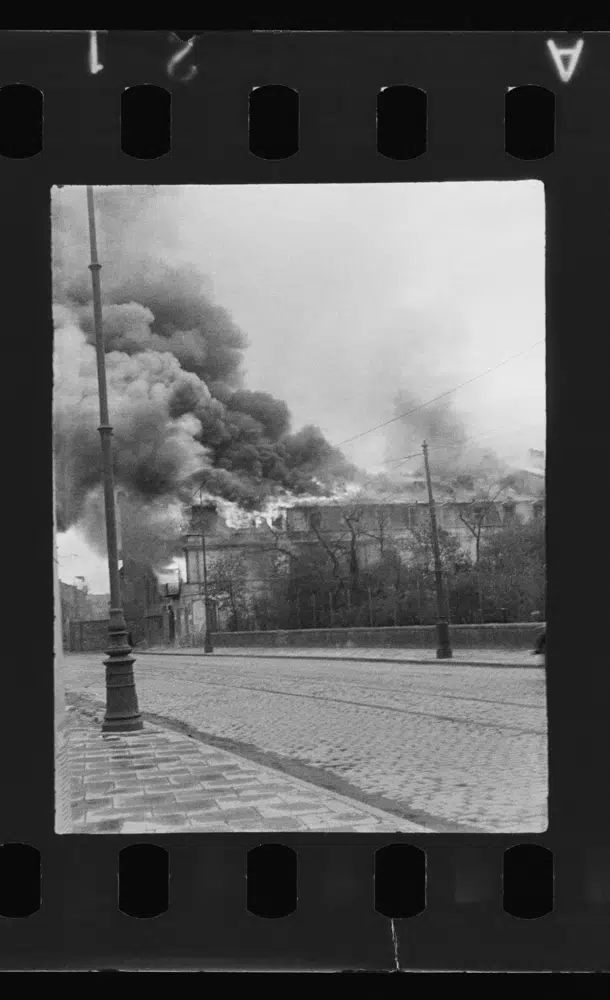
In December 2022, a collection of photograph negatives was discovered in an attic belonging to deceased Polish firefighter and photographer Zbigniew Leszek Grzywaczewski who was a firsthand witness to the largest Jewish uprising during World War II. These photographs, found by Grzywaczewski’s son, Maciej, are currently the only known images taken of the 1943 Warsaw Ghetto Uprising that were not photographed by German forces with the intention of use as Nazi propaganda.
The Warsaw Ghetto Uprising
The event depicted in the newly found photographs is known as the Warsaw Ghetto Uprising, which began on April 19, 1943 and lasted for nearly a month as young Jewish fighters held off Nazi forces.
By 1943, Warsaw had been under German occupation for nearly four years, and its Jewish inhabitants forced into a large ghetto within the city. They were subject to mass deportations to concentration and forced labor camps, executions, and widespread hunger, which resulted in many deaths. The Jewish population in Warsaw was reduced from several hundred thousand to a mere 55,000-60,000, according to the World Holocaust Remembrance Center.
On the eve of Passover, April 19th 1943, German forces were ordered into the Warsaw ghetto to deport the remaining inhabitants, who had barricaded themselves and prepared for mass resistance. Many of the young Jewish survivors in the ghetto had joined underground fighting organizations and armed themselves after seeing the Germans devastate the city and their communities.
The fighting between the small group of Jewish fighters and the larger Nazi forces managed to last for nearly a month, until the Germans were able to gain the upper hand and stop the uprising, with the last of the Jewish residents deported to camps.
The New Photographs
For decades, it had been thought that the only photographic documentation of the event was in the Stroop Report, a report prepared by Nazi General Jurgen Stroop for SS chief Heinrich Himmler with the intent to serve as Nazi propaganda against Jewish Poles.
That is, until Grzywaczewski’s photos were discovered. The photos were likely taken in secret as the young firefighter witnessed the events of April 19 as he and many other Polish firefighters were called in by the Germans to prevent the spread of flames outside of the ghetto. The photographs are haunting, as they show crowds of Jewish people being led by Nazi forces to holding spots, where they would await deportation. Many of the photographs show burning buildings, purposefully lit by Nazis to force people out of bunkers.
Grzywaczewski’s photographs will be part of an upcoming exhibition commemorating the 80th anniversary of the uprising at the POLIN Museum of the History of the Polish Jews in Warsaw.
References:
The Associated Press. “A Firefighter’s 1943 Photos of the Warsaw Ghetto Uprising Have Been Found.” NPR. NPR, January 21, 2023. https://www.npr.org/2023/01/21/1150586336/warsaw-ghetto-uprising-1943-photos-found.
Walker, Shaun. “Lost Photos from Warsaw Ghetto Uprising Reveal Horror of Jews’ Last Stand.” The Guardian. Guardian News and Media, January 22, 2023. https://www.theguardian.com/world/2023/jan/22/lost-photos-warsaw-uprising-reveal-horror-jews-last-stand.
“Warsaw Ghetto Uprising.” Yad Vashem. The World Holocaust Remembrance Center. Yad Vashem. The World Holocaust Remembrance Center. Accessed February 14, 2023. https://www.yadvashem.org/holocaust/about/combat-resistance/warsaw-ghetto.html#narrative_info.
Leave a Reply